Future-Fit Policy Watch – May 2026
In this blog, our Senior Policy Advisor and in-house ‘policy-watcher’, Laura Rayner, together with our Programme Lead: new economy goals, Magali Brosio, digest the new report by UN-appointed global experts, ‘Counting what counts’. It offers something potentially game-changing – the first global framework for moving beyond GDP requested by governments.
A more holistic and forward‑looking compass for progress, Beyond GDP
Highlighting the risks and inadequacies of using Gross Domestic Product (GDP) as the key measure of societal progress is core to ZOE Institute’s raison d’etre. This metric tells us nothing about whether people are enjoying good living standards, how fair and equal living standards are, or whether we are protecting the wellbeing of future generations.
The counterproposal is to move ‘Beyond GDP’. This means adopting a more holistic set of indicators that better capture sustainability, inclusion, and wellbeing.
Over the years we have seen significant headway made at all levels of government; from cities adopting doughnut economics, to the establishment of the OECD Centre on Well-being, Inclusion, Sustainability and Equal Opportunity (WISE), and the European Commission’s Sustainable and Inclusive Wellbeing Dashboard. Nonetheless, these efforts remain fragmented and with limited policy uptake.
First global Beyond GDP dashboard
All the same, yesterday’s publication by the UN High‑Level Expert Group on Beyond GDP of its report, ‘Counting what counts’, is a historic moment.
Appointed in May 2025 by UN Secretary‑General António Guterres, the Expert Group was tasked by member states with developing a conceptual framework that identifies the key dimensions of societal progress, and with proposing an initial set of country‑owned, universally applicable indicators of sustainable development. Together, these elements aim to equip governments with the information they need to steer policy toward long‑term wellbeing.
The report proposes a total of 31 indicators structured around four components:
- foundational principles (peace, human rights, and respect for the planet);
- current wellbeing;
- equity and inclusion; and
- sustainability and resilience.
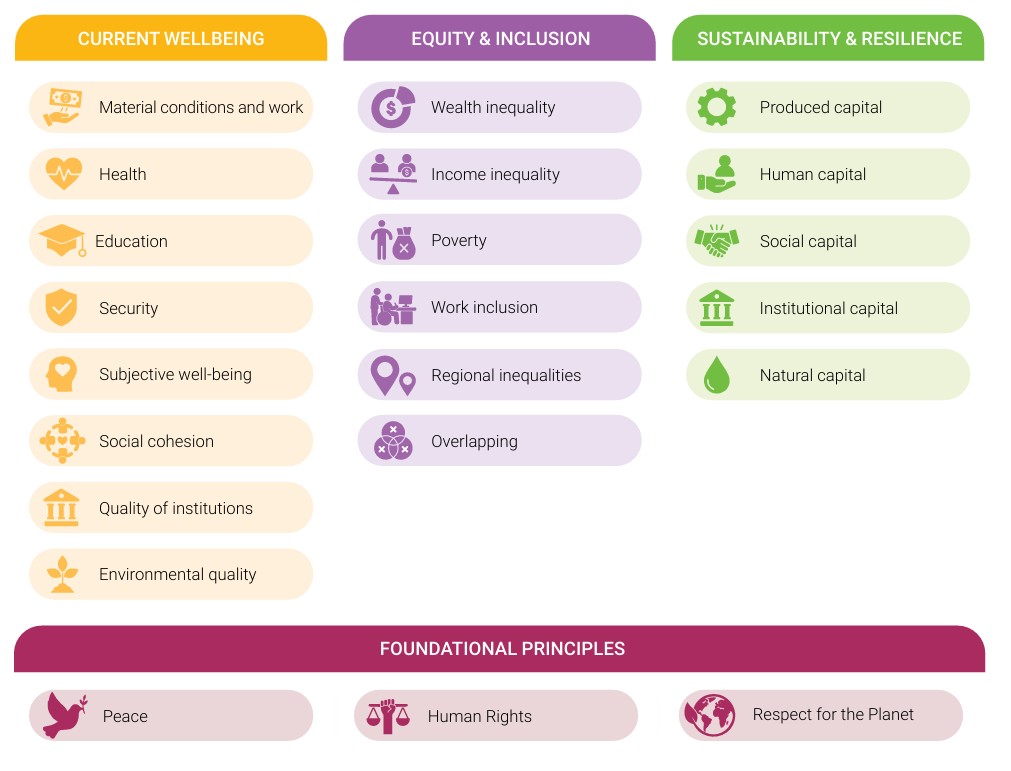
The framework aims to combine feasibility with ambition: while close to half of the proposed indicators draw on the Sustainable Development Goals, it also comprises new ‘frontier’ indicators.
The dashboard of indicators proposed by the Expert Group is an important step forward. It has the potential to strengthen the quality and availability of data and to support greater harmonisation in measurement. In turn, this could help lay the foundation for the transition that is still missing: embedding these metrics into policy processes. All in all, the dashboard should be seen as an evolving tool to be updated as the beyond GDP technical infrastructure improves.
What next?
But the test of the Expert Group’s work is what happens next. In the upcoming intergovernmental process mandated by the UN’s Pact for the Future, and with the development of the follow-up to the SDGs, these recommendations on how to move beyond GDP must guide decisions.
European countries have all the elements needed to lead this process. At EU level, the European Commission’s Sustainable and Inclusive Wellbeing Dashboard and the GDP+3 framework provide important precedents. At member state level, Italy, Ireland and the Netherlands offer valuable technical lessons that could and should serve as inspiration.
Spain has already taken steps forward, not only co-leading the Beyond GDP Global Alliance, but also cofacilitating (together with Guyana) the upcoming intergovernmental process that will follow the launch of the Expert Group report.
In today’s world seemingly marked by one crisis immediately following another, getting out of short-term response mode (often focused on growing GDP as a solution to all ills) and adopting a more holistic and forward‑looking compass for progress is a chance to move onto a more sustainable, socially just pathway for the future.