
How future-fit is the next European-Commission?
ZOE Institute’s Managing Director Elizabeth Dirth reflects on the composition of the next European Commission.
After last-minute delays and drama the composition of the next European Commission – the von der Leyen II Commission – was announced this week
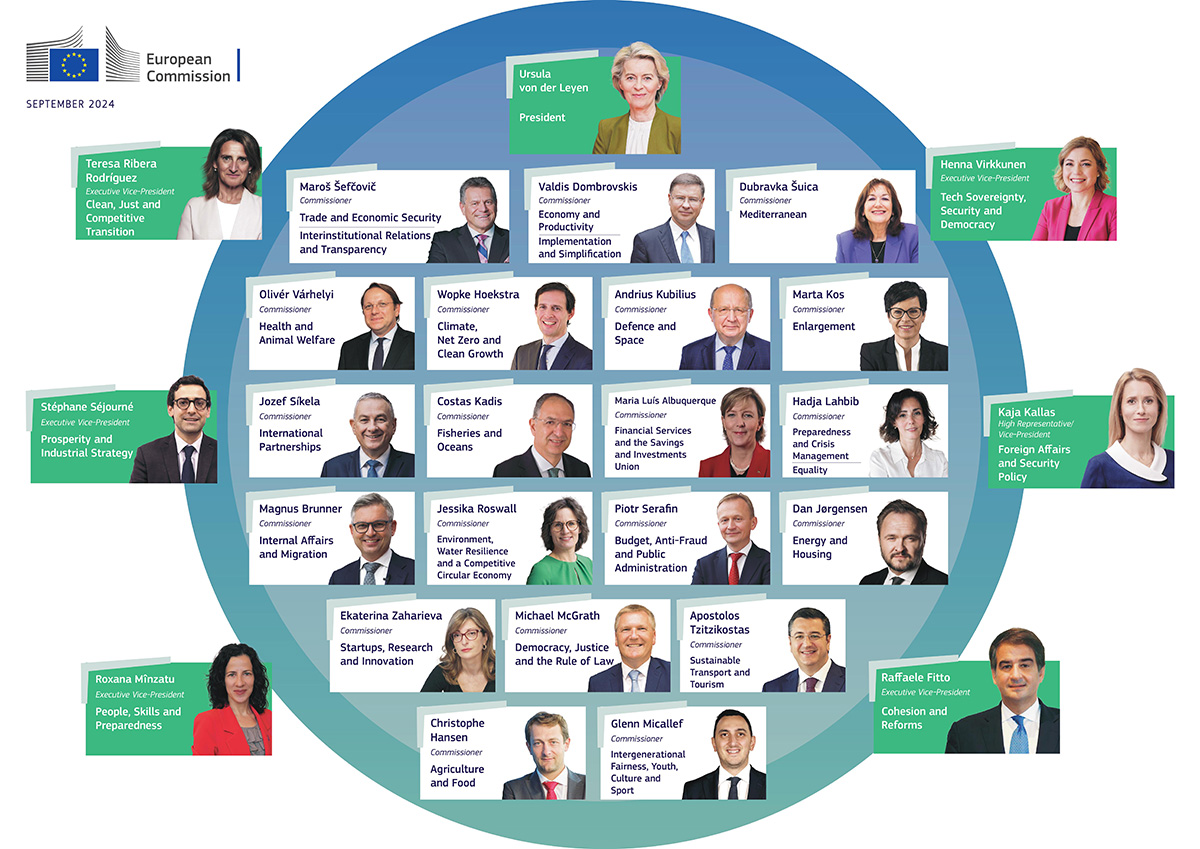
These are the 27 Commissioners and their respective portfolios, collectively referred to as the college, that will steer the EU’s executive arm for the coming five years. So much about the future of Europe hangs on these individuals and their remits. The structure and priorities of the Commission will shape the key topics where political leadership is needed, and these individuals will be expected to handle tricky topics, in uncertain times, with unprecedented complexity and in the face of massive change.
A step forward for intergenerational fairness
For the first time, the college includes a role with explicit responsibility for Intergenerational Fairness. Considering that “solidarity between generations” is in the EU treaties, this has been a long time coming. One could even say it’s been 32 years in the making.
This new role, which has been allocated to Malta’s nominee Glenn Micallef, is a signal von der Leyen wants to strengthen the long-term perspective and better balance the interests of present and future generations. This is an important step forward.
However, it’s crucially important that intergenerational thinking is not done only for young people. It is also needed for competitiveness, democracy, economic security, the green and digital transitions and all the priorities of the next Commission.
Long-view decision-making does not equal youth policy, or vice-versa.
The challenge will be for Glenn Micallef to assert this new remit and make himself a focal point for long-term thinking in the system. While foresight has been an important feature of the last Commission, it is less present in the new portfolios. Uncertainty and ‘polycrisis’ call for more use of foresight methods, not less. The current Commission made important progress on ‘future-thinking’ over the last five years – it’s crucial that this is used and built-on and that a Commissioner has leadership on this.
Preparedness
Another indicator that von der Leyen wants to get out of crisis-response mode and take a more forward-looking approach is the prominence of ‘preparedness’ which features in multiple Commissioners’ remits. If preparedness is delivered in a way that is horizontal, uses foresight tools, and informs key decisions, this can mark a big step forward in embedding a long-term and systemic approach to policymaking.
A holistic approach to the economy?
What’s remarkable is the number of portfolios that either implicitly or explicitly connect to the economy. This could result in a contest for territories and create an ever more siloed Commission. Or it could result in a much more collaborative, holistic approach to the economy, where perspectives on climate, jobs, circularity, agriculture and other topics are brought together in policy.
Such collaboration is not just a nice to have. To fully harness Europe’s industrial potential, collaboration between the Executive Vice President commissioners is absolutely necessary. Boosting Europe’s overall competitiveness will only succeed if the economic potential of currently left-behind regions is fully realised.
How the appointed commissioners respond to the challenge of working together will determine the fate of Europe’s economy.
Only a holistic and multi-level approach to economic policy-making can lead to prosperity for all.
Here, it would be remiss for me not to mention that while I am pleased to see that von der Leyen succeeded to make sure that 40% of Commissioner are women, the majority of the heavyweight economic portfolios have gone to men. Gender balance also means portfolio balance across genders. This outcome is out of touch with the number of top-notch female economists around Europe.
Implementation
Implementation, and specifically of the European Green Deal, is clearly a backbone of the majority of the portfolios. While not as explicit as it could be, it is part of the raison d’etre of many of the portfolios, including the six most powerful Executive Vice Presidents.
I look forward to seeing how the new team von der Leyen rises to the challenge of bringing a just, green transition to life.