
Future-Fit Policy Watch – February 2026
In this blog, our Senior EU Policy Advisor and in-house ‘policy-watcher’, Laura Rayner, gives her take on recent events in and around Brussels. This time she reflects on this month’s EU leaders’ retreat and calls from UN Secretary General António Guterres to go ‘beyond GDP’.
Treading the line between open markets and protectionism
European Commission President Ursula von der Leyen said in her keynote speech on the first anniversary of the Draghi report on the future of EU competitiveness:
“We can move mountains when we have the ambition, the unity and the urgency.”
Considering that we are 532 days (as of today 23 February) on, with little substantial progress to show for it, it begs the question of whether the EU, or more precisely, the 27 member states, have the ambition, unity and urgency to act?
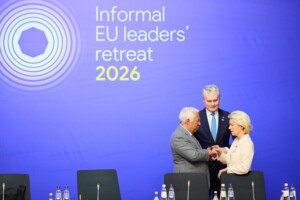
Credit: European Union 2026 / Dati Bendo
The retreat of EU leaders this month focused on competitiveness and strengthening the Single Market in the hope that unity (if not ambition or urgency) can be found in advance of the next Council summit in March.
Nevertheless, there still appears to be vast differences between the national capitals on crucial issues which will ultimately require compromise if the EU is to progress on some of Draghi’s key action points, e.g. the Savings and Investment Union, local content requirements (so-called ‘Made in EU’), and supporting Europe’s clean tech manufacturing.
Rhetoric is all very well. Improving competitiveness is an agenda all EU member states agree on (even if a common definition of this is lacking – as identified by ZOE’s research efforts here). Strengthening resilience is too. Yet translating these high-level, non-specific ambitions into workable proposals is, of course, very difficult.
Reaching consensus among 27 member states, all with challenging domestic agendas, often in the context of growing levels of political polarisation at home, results in EU leaders reciting speaking points for domestic audiences rather than showing a fundamental willingness to act together. As has always been the case in Brussels, member states may need to accept that they will lose on smaller points to win on the bigger scale. But their willingness to give even a little ground for now appears to have vanished.
Yet in this world of intensifying geoeconomic competition, more assertive use of defensive trade measures by formerly reliable partners, and rapid technological shifts, Europe’s export-oriented, growth-dependent economic model is under significant pressure. Responding to this environment with fragmented national strategies results in duplication, lack of coordination, unnecessary complexity and disparate funding streams unlikely to be large enough to support the investments that Europe desperately needs.
The months following the outbreak of the Covid-19 pandemic forced more EU common action than most of the previous decade. Can European leaders only find this level of ambition, unity and urgency when their populations are placed at short-term deadly risk? Or will the very significant long-term risks we face as a continent provide enough impetus for concrete steps forward at the next EU summit?
An EU budget for sustainable and inclusive wellbeing?
As we head into the years of fun that are the revision of the EU’s seven year budget (the multiannual financial framework, or MFF for short), it is worth reflecting on comments made this month by UN Secretary General António Guterres:
“GDP tells us the cost of everything, and the value of nothing. Our world is not a gigantic corporation. Financial decisions should be based on more than a snapshot of profit and loss.”
GDP was never intended to measure human progress, yet it remains the dominant benchmark of success.
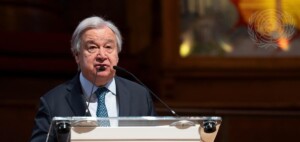
Credit: UN Photo / Alba Garcia Ruiz
ZOE has been working for many years on better ways to measure progress, helping governments assess whether development is actually improving human wellbeing, equity and sustainability, now and for future generations. Through our work with the Welsh Government and Wales’s Future Generations Commissioner, the European Commission and also in the context of the work of the UN High-level Expert Group on Beyond GDP we have has provided design advice on indicators, models and policies which improve the way we measure success.
With competitiveness the dominant rhetoric of this mandate at EU level, and with the nationalism, inequality and polarisation that currently exists in many European nations, it is vital that ordinary European citizens can see that political decisions are being taken with their best interests in mind, not in the interests of the few most powerful or wealthy. Improving Europe’s competitiveness or growing our GDP does not automatically mean that poverty, exclusion or violations of human rights decrease.
We need to improve our accounting systems and policymaking processes to properly assess how our decisions may impact wellbeing, sustainability and inclusion, for now and for the future. Integrating that thinking into the EU’s seven year budget would be a very significant step in the right direction.
