
Future-Fit Policy Watch – April 2026
In this blog, our Senior EU Policy Advisor and in-house ‘policy-watcher’, Laura Rayner, gives her take on recent events in and around Brussels. This time she reflects on the oil and gas crisis triggered by the Iran war and the EU’s options to – albeit belatedly – improve its energy independence.
What happened to the ‘Zeitenwende’?
Europe is yet again paying a painful price for its fossil fuel dependence.
Four years have passed since the Russian invasion of Ukraine made this strategic vulnerability abundantly clear. But it was decades in the making.
By replacing a regional fossil fuel dependence with a global one, and by making too little effort to decarbonise or properly integrate European suppliers, grids, and buyers, Europe has kept high fossil fuel prices a long-term structural problem. Now, short-term decisions have left Europe reliving a crisis that should not need repeating.
In 2022, then German Chancellor Scholz called for a ‘Zeitenwende’, or ‘turning point’, in the continent’s energy dependence.
Unfortunately, the current situation suggests we didn’t turn, we just kept going.

Futures price for UK natural gas. Sources: Bloomberg, via BBC
What is required to achieve such a turning point is well understood: decarbonisation of European industry and lifestyles. For this we need to increase roll-out of renewable energy and much more rapid efforts to improve and integrate electricity grids. And it is not as if these solutions or pathways aren’t available.
In 2024, the ZOE-hosted Energy Independence Council modelled how Germany could pay for and achieve a 78% reduction in Germany’s dependence on natural gas. Many others have presented similar policy solutions which would have limited our exposure to the economically damaging price spikes and trade disruptions we’re experiencing now. The immediate policy response to the high energy prices caused by the Iran war must be to protect vulnerable households and firms. But even emergency measures should be designed to accelerate energy savings and renewables, not to prop up the polluting status quo.
Subsidies and cash transfers should be timebound and conditional on investments in efficiency, heat pumps, insulation and electrification – measures that lower bills while cutting emissions and reducing our reliance on fossil fuels from other parts of the world.
Greater independence can come from deepening the internal energy market. Europe would be more resilient if electricity could flow freely across borders when and where needed. A more integrated market would reduce price spikes, minimise demand peaks and supply shortages, and let countries access regional backup.
The latest crisis has again made clear the limits of the short-term and national responses so far.
Given some countries can borrow cheaply to shield citizens and industries and others cannot, temporary EU fiscal instruments linked to green transition objectives would reduce fragmentation and prevent competitive, short-term industrial bailouts. These could be for instance, emergency liquidity lines or targeted joint borrowing to finance energy efficiency retrofits and electrification.
Support for energy intensive sectors, as part of a forward-looking industrial policy, needs to prioritise decarbonisation pathways: progress-dependent principles can direct public support to the private sector in a more effective and efficient way through setting binding progress targets, establishing performance-based incentives and allowing for open and fair access to direct support.
Finally, the political dividend of prudent, visible solidarity at the EU level should not be underestimated.
Initiatives such as coordinated buying in the face of market squeezes, redistribution of supplies to areas under acute stress, and clear rules for conditional support, can demonstrate the added value of EU cooperation. It can be an opportunity for the EU to demonstrate that it is not a distant technocratic apparatus but a practical partnership – one capable of standing together in the face of intimidation, reducing vulnerability and sharing the costs of transition fairly.
For all of this, EU member states must be willing to work together.
This crisis should be a catalyst.
If European leaders take this moment to speed up renewables deployment, deepen market integration and better target EU fiscal support, the result will be a Europe that is cleaner, cheaper and, ultimately, more secure.
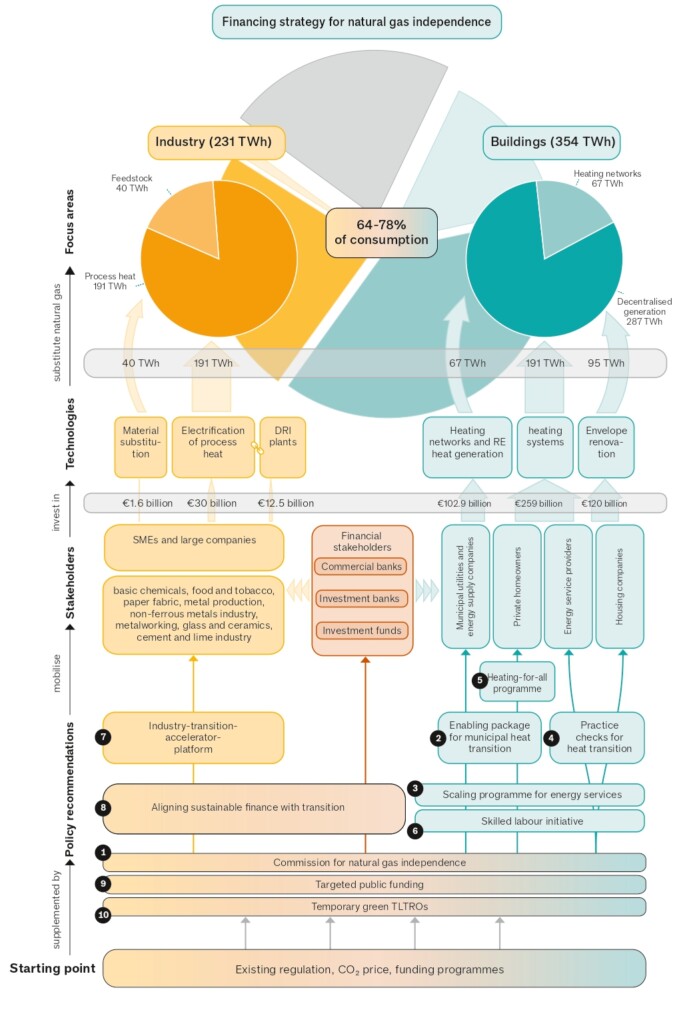
Financing strategy for natural gas independence in Germany, from the ZOE-hosted Energy Independence Council report ‘Security-orientated energy policy’
