Descending from the UN Summit of the Future
By Christiny Miller & Nicole Kormann
Live from New York, it’s Monday night!
The United Nations Summit of the Future is drawing to a close. This extraordinary gathering of world leaders was focused on updating structures of global cooperation so countries can effectively work together for the long-term good.
While ZOE Institute usually works at the EU and national level, multilateralism and global governance have a crucial role in achieving our shared goals. Here we share some reflections on the past few days in New York.

First to say it was an absolute whirlwind. We landed in New York on Wednesday and already Thursday kicked off the occasion with the Building Hopeful Futures Festival, organized by our friends at the School of International Futures. Through the fog of jetlag and fueled by American-sized cups of coffee, Christiny contributed to a panel alongside inspiring leaders, where she spoke about ZOE Institute’s work on future generations in the EU and the latest news on the appointment of a European Commissioner for Intergenerational Fairness. The discussion heard diverse perspectives from around the world on different dimensions of ‘hopeful futures’.
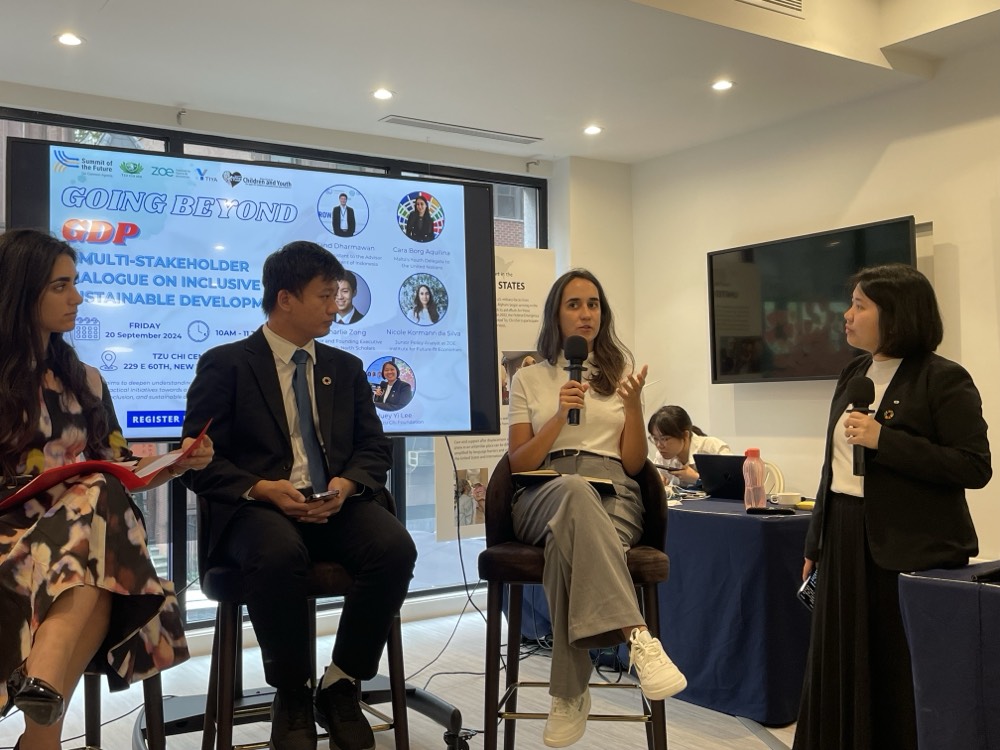
The official side events began on Friday with the Action Days – the two days preceding the Summit which brought together diverse stakeholders for a packed agenda of events related to the Summit. We took part in 10 events, engaging in discussions on key topics such as philanthropy for the future, systems approaches, strategic foresight for decision-making, and how to implement the commitments in the Pact for the Future, one of the main outcomes of the Summit. Nicole also shared insights as a panelist on ‘beyond GDP’, collaborating with a group of inspiring youth delegates to shape the conversation.
As an added bonus, we got our copies of The Ministry for the Future signed by author Kim Stanley Robinson who presented his book at the Action Days.
The side events and the corridors of UN headquarters were great both for meeting new people and seeing project partners. We met members of the MERGE project, and gathered the members of the Network of Institutions of Future Generations.

Sunday was the kick-off of the Summit itself, and it started with a bang—the Pact of the Future was adopted along with the Declaration on Future Generations. This is a HUGE win and a very exciting way to begin.
The Pact of the Future is an agreement negotiated internationally which outlines 56 actions to take for a brighter global future. It includes actions for sustainable development, peace and security, innovation, youth and future generations, and transforming global governance. Action 53 was of particular interest to us:
“We will develop a framework on measures of progress on sustainable development to complement and go beyond gross domestic product.”
The Declaration on Future Generations puts forth guiding principles to observe in order to:
“fulfil our commitment to meet the demands of the present in a way that safeguards the needs and interests of future generations, while leaving no one behind”.
These principles are followed by a list of commitments and actions which give governments a list of clear steps to take to protect the interests of future generations, like using strategic foresight and data for long term planning, promoting forward-looking impact assessments, and undertaking a whole-of-government approach to policymaking, to name a few.
Now the work must begin to implement what is outlined in the Pact and Declaration. This is necessary globally as with any global agreement, but we are especially keen to see how Europe will take this forward. The good news is that Europe has already offered words of support. President of the European Council, Charles Michel, stated:
“The Pact of the Future sends a powerful signal of confidence that despite our differences, despite the challenges we face, we can work together and we want to work together”.
With the Pact adopted, it is not yet time to rest with this victory—the work starts now. In the words of UN Secretary General Antoinio Guterres:
“our success or failure hinges not on the adoption of agreements but on our actions and the lives of the people that we serve”.