Future-Fit Policy Watch – July 2026
In this blog, our Senior EU Policy Advisor and in-house ‘policy-watcher’, Laura Rayner, gives her take on recent events in and around Brussels. This time she looks at the EU’s deepening trade deficit with China, plus the recent World Inequality Lab ‘Plan for Equality & Prosperity Within Planetary Boundaries’.
China on the agenda, implicitly at least
Meetings of EU Heads of State increasing have China on the agenda, even if not explicitly mentioned.
The elephant in the room is instead referred to as ‘geoeconomic imbalances’ or ‘derisking European supply chains’. June’s meeting was no exception with a discussion point on ‘global macroeconomic imbalances’.
This is all code for the trade disparity between the EU and China, which is worsening. In the two years from 2024 to 2026, the EU’s trade deficit in goods with China increased by a third – from €65 billion to €98 billion.
Reducing Chinese market access; encouraging Europe’s industrial capacity; trying to diversify the EU’s supply base to other countries; ensuring importers a level playing field in terms of environmental costs – European politicians have suggested all of these measures as part of efforts to rectify this imbalance.
But so far, the EU appears paralysed to respond adequately, in large part due to splits between member states. France has long pushed for a more active industrial policy with more emphasis on protecting European manufacturers. While Germany, with its large industrial base, has been keen to ensure its access to the Chinese market, both for suppliers and buyers.
With the EU’s two most prominent member states in disagreement, successive summits have made little progress on a way forward. But, with German industries more and more severely impacted by Chinese dominance, this is unlikely to hold. We are finally reaching a point where Europe may become more overt in its trade defence.

Commission President von der Leyen, with Kaja Kallas and António Costa, on a visit to China in 2025 ((c) EC audiovisual service | Raul Ariano)
If Europe does decide to act to encourage domestic industrial capacity through financial support, this must be allocated selectively and strategically.
–> Read more: Progress Over Promises – Rethinking direct public support through a progress-dependent conditionalities regime
Rather than prioritising sectors struggling in the short-term, Europe needs to look ahead and give direct support to the industries it needs for long-term resilience. While in the meantime supporting sectors which will be phased-out and experience job losses in the transition process.
Government funding should be tied to performance, not promises. And there needs to be long-term stable direction of travel to give businesses the certainty they need to invest.
With a myriad of urgent topics competing for attention at each European Council meeting, a unified EU response will still take time. But, with Europe’s trade deficit with China only deepening, at some point the elephant will become bigger than the room.
Do look up! and into the future
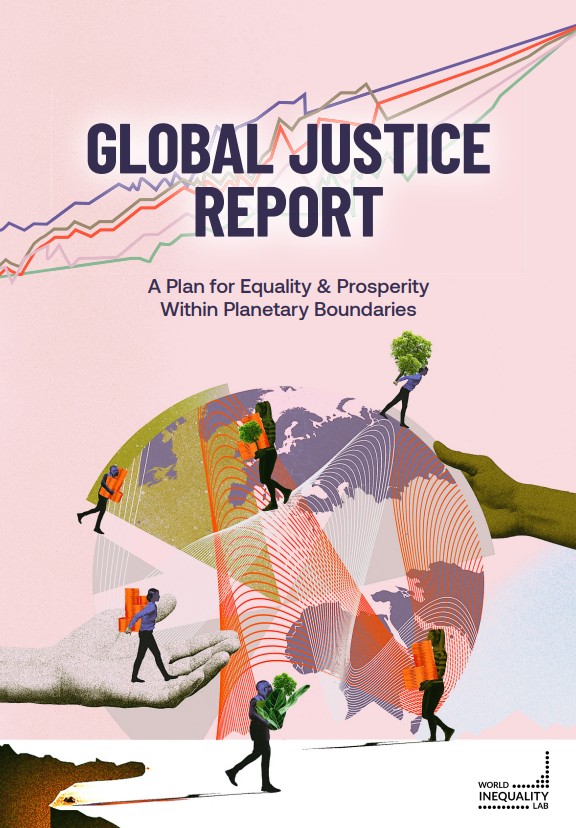
The Global Justice Report, by Thomas Piketty, Lucas Chancel and others from the World Inequality Lab, published at the start of June, presents a pathway towards a world in which human development and equity are grounded in planetary sustainability. It is a transformational vision that offers an antidote to the bleak, unimaginative standard state of the debate.
Taking the vision for the world as outlined in the Global Justice Report as our north star may take political bravery, but it would offer a positive, ambitious and hopeful direction of travel as a counterweight to the exclusionary, divisive perspectives being pedalled by extremist parties.
After being battered by one crisis after another, it feels like political attention has become so focused on the here and now that there is no longer space to look up and into the future.
It is increasingly clear that technological progress and productivity gains alone will not secure broadly shared prosperity. Systemic inequality corrodes our adaptive capacity: unequal societies invest less in human capital, underutilise talent, and feed political fragmentation. High inequality amplifies vulnerability to shocks, while concentrated capital can skew innovation toward rent extraction rather than public goods.
ZOE’s vision is of resilient, inclusive, and low-carbon economies. These aims are mutually reinforcing.
Unfortunately, while we are seeing progress on some fronts (for instance, the EU’s efforts to reach its 2030 climate targets), we are also living through times of rising wealth concentration, stagnating wages, and uneven access to public services. None of this bodes well for the state of our economies, democracies, or society more broadly.